Why Thin or Generic Legal Content Can Underperform
Thin or generic legal content can underperform when it gives readers little original value, fails to address search intent or does not demonstrate legal expertise. At LawyerSEOMarketing.com.au, we address these weaknesses through detailed Legal Content Writing and On-Page SEO built around each practice area and audience.
Why Thin Legal Content Becomes a Law Firm SEO Mistake
Thin legal content becomes an SEO mistake when a page fails to answer the reader's legal question with sufficient clarity, relevance and useful detail.
Thin content gives readers too little help to understand their situation or decide what to do next. Generic legal content may mention a practice area or service, but it often lacks the detail that makes the page relevant to a real client problem.
That weakness affects law firm SEO because search engines assess how well a page serves a query. It also harms user experience when visitors must search elsewhere for basic explanations, likely issues and practical next steps.
The Content Problems That Make Legal Pages Underperform
Legal pages underperform when their content quality does not match the reader's question or show meaningful legal expertise. The table below connects common page types with the content problem we look for.
| Page type | Common weakness | What useful content should do |
|---|---|---|
| Practice area pages | Broad claims with little explanation of the legal issue | Explain the situations covered and the questions clients commonly ask |
| Service pages | A list of services without a clear client problem | Connect the legal service with the decision the reader is trying to make |
| Legal blog posts | Keyword-focused writing that leaves important questions unanswered | Provide clear legal analysis, context and sensible next steps |
Mistake 1: Publishing Practice Pages With Too Little Useful Detail
Law firm practice pages need enough content to explain the relevant practice area and the legal services connected with it. A thin practice area page often names a service without answering the reader questions that shape an enquiry.
This problem happens when a page is written as a brief description instead of a useful guide. The cost is weaker content depth, lower page relevance and a poorer path from legal information to contact.
We fix the problem by mapping the page to real client needs, expanding the relevant legal subject matter and organising the content around clear questions.
Mistake 2: Reusing Generic Legal Copy Across Multiple Pages
Generic legal copy makes separate pages sound interchangeable when each practice area should have a distinct purpose. Template content can also create duplication across a law firm website.
This happens when the same introduction, service description and call to action are copied across pages. The cost is weaker practice area differentiation and less useful information for readers.
We fix it by giving each page its own audience, query focus, legal context and supporting explanations. Relevant internal linking then helps users move between related pages without making the pages compete for the same purpose.
Mistake 3: Writing for Keywords Without Answering Search Intent
Keyword targeting works best when the page answers the search intent behind the query. A page can include a keyword but still fail if it does not meet informational intent or commercial intent.
This happens when writers focus on keyword relevance without asking what the searcher needs at that stage. The cost is a mismatch between the query and the page, which can weaken engagement and lead quality.
We fix the issue by identifying whether the reader wants an explanation, guidance about a legal problem or information about engaging a legal service. We then shape the content so the answer appears clearly and naturally.
Mistake 4: Describing Legal Services Without Explaining the Client Problem
A legal service page should explain the client problem that the service addresses. A list of legal services does not give enough context for a person deciding whether the page applies to their case.
This mistake happens when copy describes what the firm does but not why a reader may need it. The cost is lower service relevance and more uncertainty about the right next step.
We fix the page by adding case context, common triggers and practical questions linked to client needs. That approach helps readers understand where the service fits without promising a particular legal outcome.
Mistake 5: Making Expertise Claims Without Showing Useful Evidence
Legal expertise becomes more credible when a page shows useful legal analysis and first-hand knowledge through its explanation. A claim of expertise alone does not help a reader assess whether the content is reliable.
This happens when marketing language replaces substance. The cost is weaker trust signals and content that does not demonstrate why the page deserves attention.
We fix this by explaining relevant legal concepts, limits, decision points and common sources of confusion. Helpful content shows expertise through its reasoning, not through unsupported labels.
Mistake 6: Ignoring the Questions People Ask Before Contacting a Law Firm
Frequently asked questions help a page address the client questions that arise before contact. Readers often need to understand their position before they are ready to discuss a matter with a law firm.
This mistake happens when content moves straight from a service description to a call to action. The cost is a weaker user experience and a missed chance to support legal decision-making.
We fix it by reviewing search behaviour and adding clear answers where they improve the page. The questions must relate to the page purpose and guide the reader towards a sensible contact decision.
Mistake 7: Creating Pages That Compete With Each Other
Keyword cannibalisation occurs when multiple pages on the same law firm website target overlapping topics without clear roles. Internal competition can make it harder for search engines and readers to understand which page answers a query.
This happens when content architecture grows without a defined page purpose. The cost is diluted relevance, confusing internal linking and duplicated effort.
We fix it by assigning each page a clear topic, audience and search intent. We then use internal links to connect related pages while keeping their purposes distinct.
Mistake 8: Treating On-Page SEO as Metadata Only
On-Page SEO covers more than title tags and meta descriptions because content structure also affects how a legal website serves readers. Heading structure, body copy and internal links all help communicate page relevance.
This mistake happens when metadata is edited without improving the underlying page. The cost is a page that may describe the right topic in its title tag but provide little useful information after the click.
We fix it by aligning the title tag, headings, content structure, internal links and call to action. Our Legal Content Writing supports that work by making the page useful as well as technically organised.
How We Diagnose Thin or Generic Legal Content
LawyerSEOMarketing.com.au diagnoses weak legal content by checking the page's purpose, search intent, topical coverage, differentiation and on-page structure.
Our content audit begins with the page's role in the wider law firm website. We review whether the page answers the intended query, covers the practice area properly and gives readers a clear reason to continue.
We also assess competitor analysis, internal linking and the relationship between related pages. This helps us separate a genuine coverage gap from a structural problem, such as overlapping pages or unclear navigation.
How to Improve a Thin Law Firm Page
Content improvement works best when the page is rebuilt around its legal subject matter, reader questions and intended action. We use a structured review so the new copy adds value instead of simply adding words.
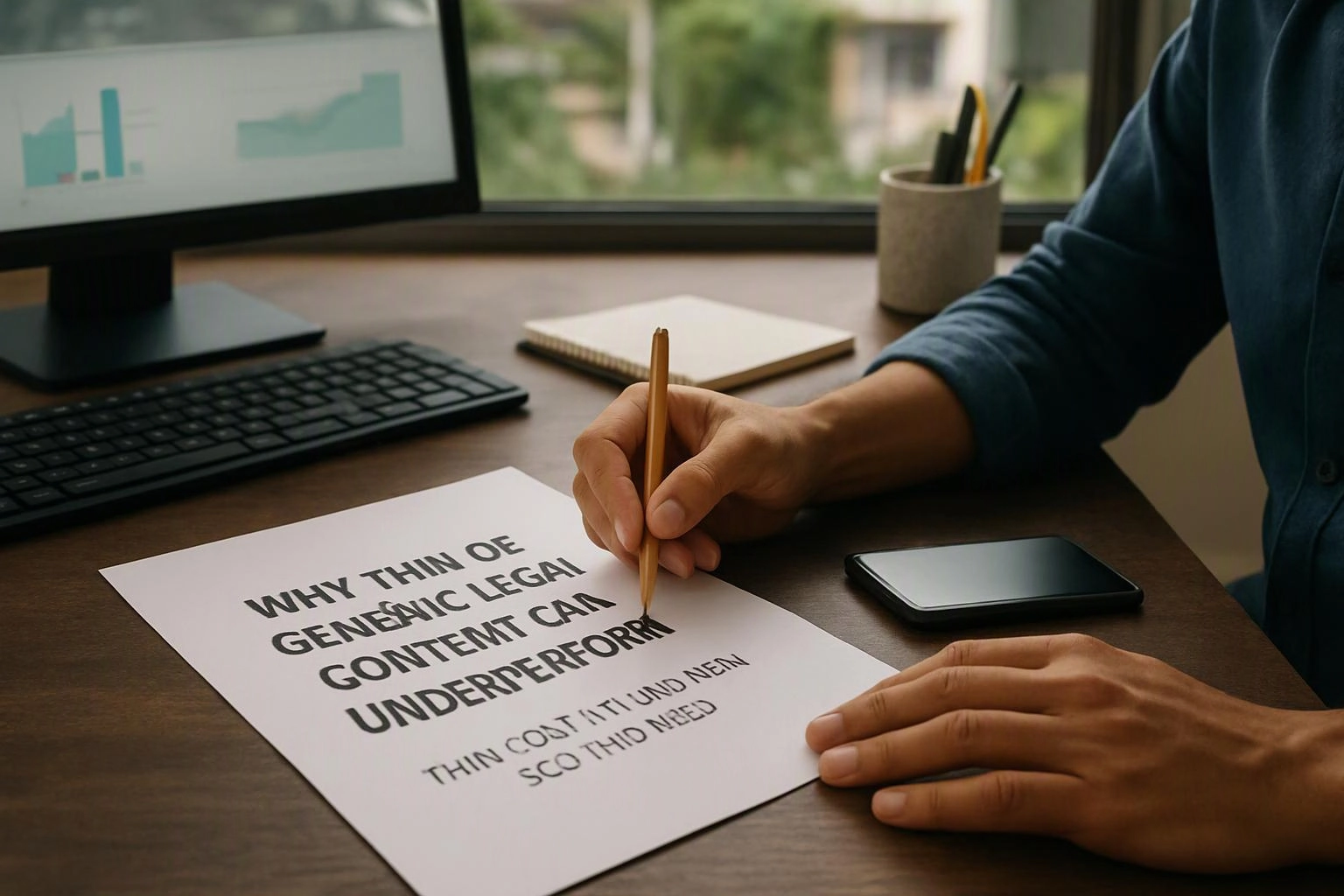
A stronger page does not need filler or repeated keywords. It needs clear coverage that helps a reader understand the issue and decide what to do next.
When to Ask Us to Review Your Legal Content
Ask us to review your legal content when weak page performance appears connected to thin coverage, generic wording, unclear intent or poor structure.
Our team can review a law firm website when the content no longer reflects the practice areas or questions that matter to its audience. We focus on practical improvements that support both readers and search visibility.
What Strong Legal Content Should Help a Reader Do
Strong legal content should help a reader understand their issue, assess the relevance of a legal service and choose a sensible next step.
Useful legal information answers the reader's main question before introducing related detail. It explains the case context in plain language and makes the limits of general information clear.
A good user experience also provides a clear conversion path. The reader should know which page to explore next, what information to prepare and when contacting the law firm may be appropriate.
That combination of reader needs, legal expertise, content quality and internal linking gives a law firm website a stronger foundation for search visibility and meaningful enquiries.