
When Law Firm Pages Compete With Each Other
Law firm keyword cannibalisation mistakes occur when multiple pages target the same search intent, causing unclear relevance and weaker internal signals; LawyerSEOMarketing.com.au audits page purpose, keyword mapping, content overlap and internal linking to establish a clear target for each page.
What Is Keyword Cannibalisation for a Law Firm?
Keyword cannibalisation is a search visibility problem that occurs when multiple pages target the same search intent without clear differences in purpose.
A law firm website may have a practice area page, a legal service page and a blog article that all discuss the same legal topic. When those pages overlap heavily, search engines may struggle to select the page that best answers the query.
The issue is not simply that several pages mention the same words. The central problem is unclear page purpose, weak separation between search intents and signals that do not identify a preferred page.
How We Identify Competing Law Firm Pages
An SEO audit identifies competing law firm pages by comparing each URL's target keyword, search intent, content focus, rankings and internal links.
Our review treats competing pages as a site architecture problem, not only as a keyword problem. We assess how the URLs work together across the law firm website.
Mistake: Giving Several Practice Area Pages the Same Primary Keyword
Several practice area pages with the same primary keyword create unclear page relevance.
This mistake happens when keyword mapping assigns one broad legal term to multiple pages without separating service scope or search intent. Each page then competes for the same audience and may repeat similar body content.
The cost is diluted search visibility and less useful landing-page choices for visitors. We fix the issue by assigning one main purpose to the strongest page and giving related pages distinct supporting topics.
Mistake: Creating a New Page for Every Keyword Variation
A new page for every keyword variation can create thin content and unnecessary competition.
This mistake happens when each similar search query is treated as a separate topic, even when the search intent is the same. Small wording changes do not always justify another URL.
The cost is a larger site with weaker pages and more maintenance work. We fix it by grouping close keyword variations into a useful topic cluster and building one substantial page where the intent is shared.
Mistake: Splitting One Legal Service Across Similar URLs
Splitting one legal service across similar URLs can make the service scope unclear.
This mistake happens when URL structure follows internal labels instead of meaningful differences in the service. Similar practice area and legal service pages may then repeat the same explanations, outcomes and calls to action.
The cost is weaker page relevance and a confusing journey for potential clients. We fix it by defining the service scope, choosing the clearest URL and consolidating content where the pages answer the same need.
Mistake: Copying the Same Practice Area Content Across Locations
Copying the same practice area content across locations creates duplicate content and weak local relevance.
This mistake happens when location pages change only the place name while keeping the same legal explanations and service wording. A location page needs a genuine local search purpose and useful unique content.
The cost is a set of pages that offers little extra value to users or search engines. We fix it by separating local intent from general practice area intent and revising each page with meaningful, accurate information.
Mistake: Using Identical Titles and Headings on Related Pages
Identical title tags and headings make related pages look interchangeable.
This mistake happens when templates repeat the same target keyword and legal topic without showing the different purpose of each URL. Search engines and readers receive fewer clues about page relevance.
The cost is weaker distinction between pages in search results and on the website. We fix it through on-page SEO that gives each page a specific title tag, heading structure and content focus.
Mistake: Letting Blog Articles Compete With Service Pages
A blog article competes with a service page when both target the same legal query and offer the same answer.
This mistake happens when an informational article is written with commercial intent, or when a service page contains a broad educational explanation without a clear conversion purpose. The content hierarchy then becomes difficult to follow.
The cost is sending potential clients to a less suitable page. We fix it by giving the blog article an informational role and the service page a clear commercial role, with links that support that hierarchy.
Mistake: Using Internal Links That Blur Page Priorities
Internal links can blur page priorities when anchor text points repeatedly to different URLs for the same topic.
This mistake happens when site architecture grows without a planned internal linking system. Blog articles, practice area pages and service pages may all receive similar links without a defined canonical page.
The cost is weaker internal signals and less clear page priority. We fix it by choosing the preferred URL, aligning anchor text with page purpose and directing relevant internal links towards that page.
Mistake: Changing URLs Without Preserving Page Signals
A URL change can remove useful search signals when the old address is not properly connected to the new one.
This mistake happens when pages are renamed, moved or rebuilt without reviewing canonical tags, backlinks and historical relevance. Search engines may treat the new URL as a separate page.
The cost is lost continuity and avoidable search visibility changes. We fix it with a suitable redirect, an accurate canonical URL and redirect mapping that preserves the relationship between the old and new pages.
Mistake: Merging Pages Without Rebuilding the Content Strategy
Content consolidation can fail when pages are merged without a new keyword strategy and clear search intent.
This mistake happens when text is copied together without deciding which sections serve the reader, which URL should remain and which content should be removed. A larger page does not automatically become a stronger page.
The cost is a page that remains unfocused and difficult to navigate. We fix it with redirect mapping, deliberate content revision and on-page SEO built around the chosen page purpose.
How to Fix Law Firm Keyword Cannibalisation
Law firm keyword cannibalisation is fixed by assigning one clear purpose to each page, consolidating unnecessary overlap, revising content and aligning internal links with the chosen page.
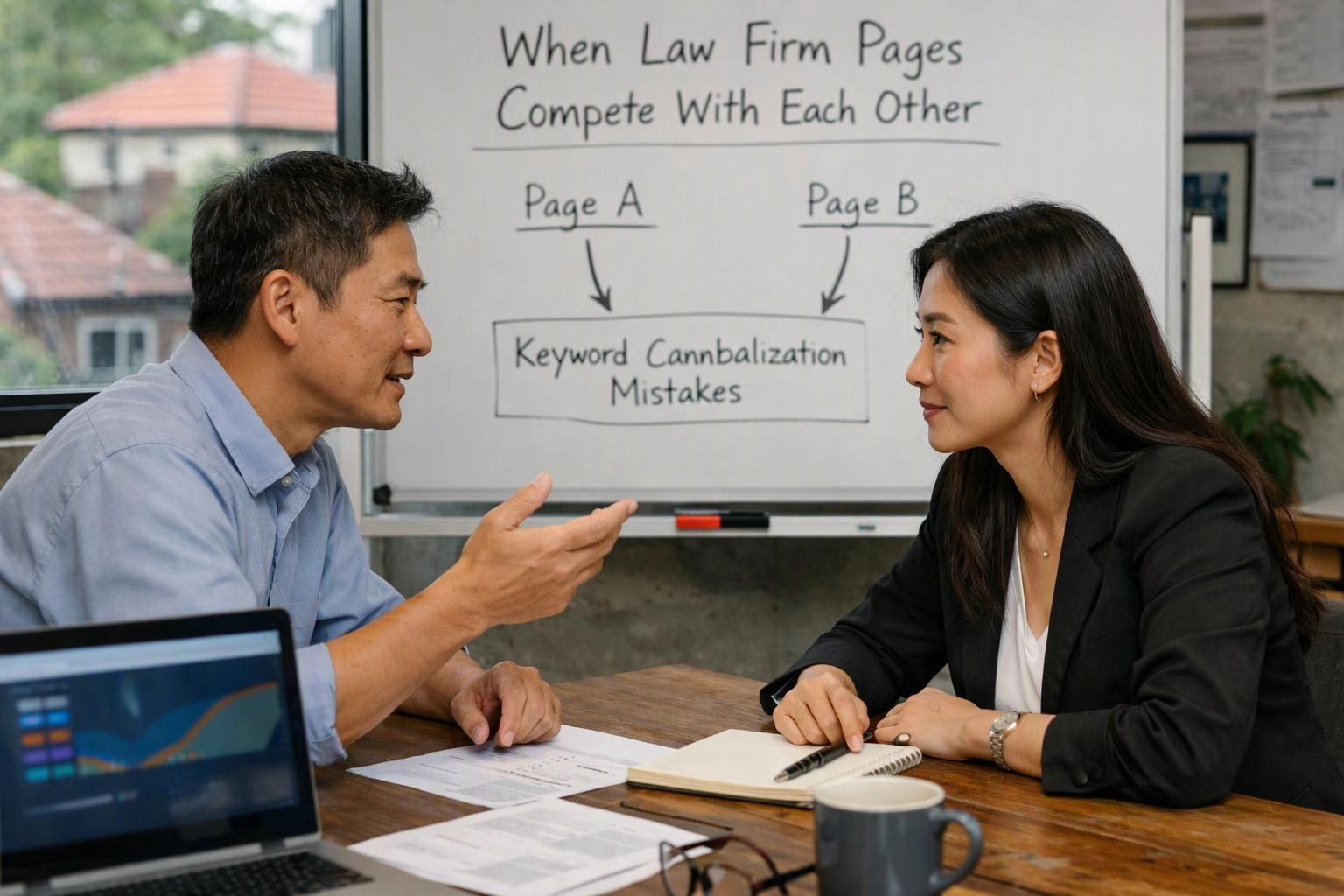
We make the decision from the relationship between page purpose, content quality and search results. The right fix may be revision, consolidation or a clearer separation of intent.
Which Page Should Target the Main Legal Keyword?
The page with the strongest match for the main legal search intent should target the keyword, while related pages should serve distinct supporting intents.
A service page usually suits a query showing a need for legal assistance. A practice area page may cover the wider legal field, while a blog article may answer an educational question. A location page should target a genuine local need, not repeat a general page.
| Page type | Best-fit search intent | Canonical target role |
|---|---|---|
| Service page | A direct need for a legal service | Main target when the query is commercial |
| Practice area page | A broad legal field or group of services | Main target when the query is broad |
| Location page | A service need with genuine local intent | Main target for the relevant local query |
| Blog article | An educational question | Supporting target for informational intent |
The canonical target should match the page that best satisfies the query, not simply the page with the most words. We use that choice to guide content, headings and internal linking.
When Should We Handle the Cannibalisation Audit for You?
LawyerSEOMarketing.com.au should handle the audit when competing pages span several practice areas, rankings are unstable, consolidation affects important URLs or the keyword map no longer reflects the site structure.
Our team can review the issue when the correct page is difficult to identify or when changes could affect established internal links and redirects. A structured review helps separate a genuine overlap problem from normal topic coverage.
How LawyerSEOMarketing.com.au Rebuilds Page Relevance
LawyerSEOMarketing.com.au rebuilds page relevance through SEO Audits, On-Page SEO and Keyword Research that connect each law firm URL to a distinct search intent.
We begin by reviewing the law firm website as a connected information system. Our team maps keywords to URLs, checks competing pages and identifies where page purpose has become unclear.
We then revise content, titles, headings and internal linking so the chosen page has a clear role. Where overlap cannot be justified, we plan content consolidation and redirect mapping around the strongest canonical URL.
Request an assessment through our contact page when competing URLs are affecting the structure or visibility of your legal content.
Questions About Law Firm Page Competition
Can two law firm pages rank for the same keyword?
Yes, two law firm pages can rank for the same keyword when each page serves a clearly different search intent. The pages become a cannibalisation risk when they offer the same purpose and compete for the same audience.
Should similar law firm practice area pages be merged?
Similar law firm practice area pages should be merged when they answer the same search intent and have substantial content overlap. Separate pages remain useful when their service scope, audience or purpose is genuinely different.
Does duplicate content cause law firm keyword cannibalisation?
Duplicate content can contribute to law firm keyword cannibalisation when similar URLs target the same search intent. The wider issue is unclear page purpose, so the fix should address both duplicated content and the site structure.
How do I choose the canonical page for a legal service?
The canonical page for a legal service is the URL that best matches the main commercial search intent and provides the clearest complete answer. Related pages should support different purposes and point internal signals towards that chosen page.
Can internal links cause law firm pages to compete?
Yes, internal links can cause law firm pages to compete when similar anchor text points to several URLs for the same topic. A planned internal linking structure helps search engines understand which page has priority.